Start with the honest part: the Obsidian Tasks plugin is very good, it is free, it is open source, and it installs from Obsidian's own community store. If it is working for you, the most sensible thing on this page is the section telling you to keep it.
The difference between the two is not a list of features. It is one decision made differently at the very bottom.
In Tasks, a task is a line inside a note. A checkbox with metadata after it —
emoji or Dataview inline fields — carrying due dates, a priority, recurrence,
a custom status. You gather them with a tasks query block wherever you want to
see them.
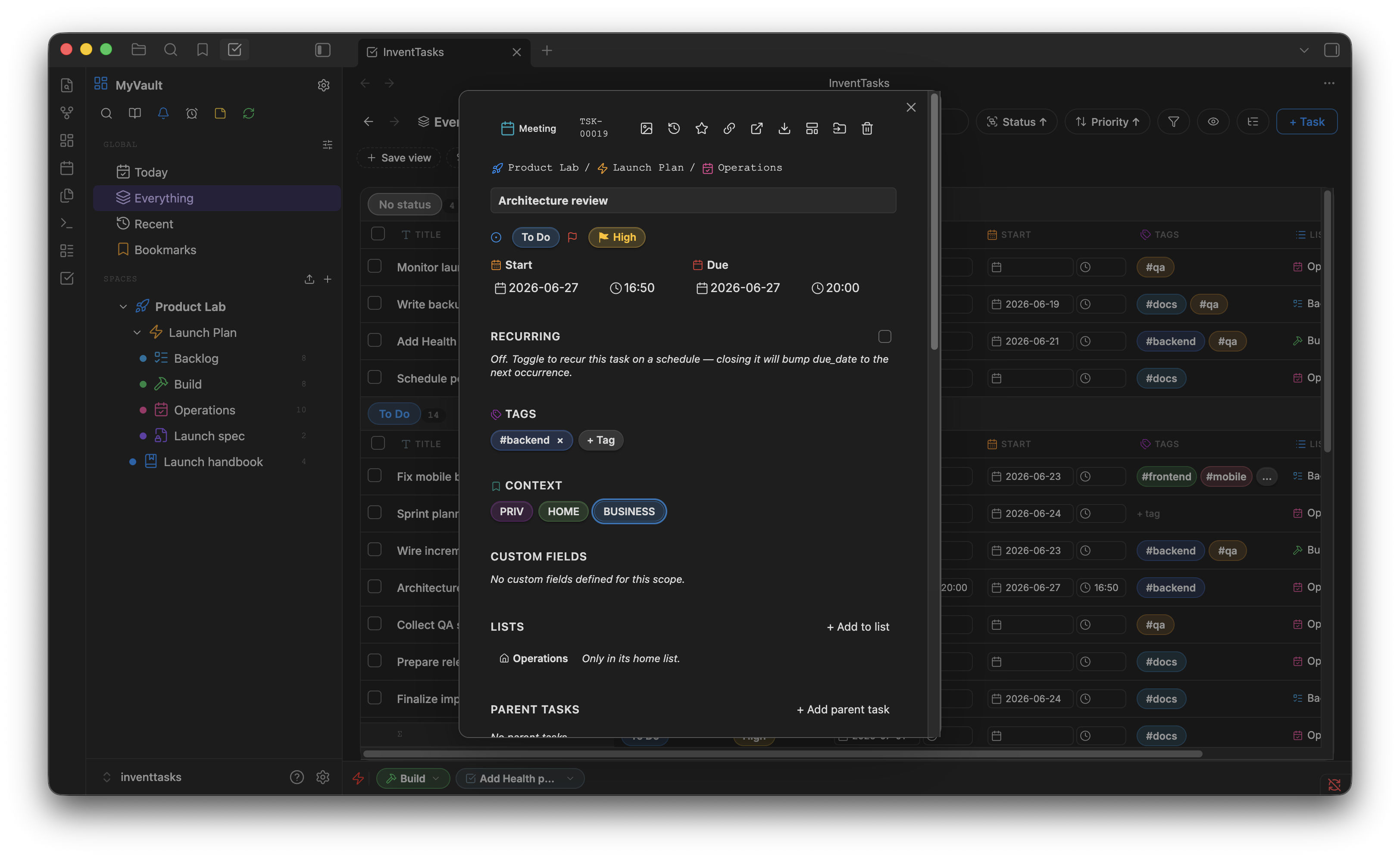
In InventTasks, a task is a note. Its own file, with typed fields in YAML frontmatter, a body you write in, and relations to other tasks and documents.
Everything else follows from that.
When Tasks is the right answer — stay put#
- Your tasks belong to the note they are in. A meeting note with five follow-ups genuinely wants five checkbox lines, not five files.
- You want it free and open source, from the official store. That is a reasonable requirement and Tasks meets it.
- You are comfortable writing queries. The query language is powerful and costs nothing to run.
- Your metadata is dates, priority and recurrence. That is exactly the set Tasks handles well.
If three of those describe you, close this page. You are not missing anything.
When a line stops being enough#
- A task needs its own fields — a client, a rate, a stage, an attachment, a rating — and cramming them onto a checkbox line stops being readable.
- You want to look at the same work several ways without writing a query each time: List, Table, Board, Calendar, Gantt, Timeline.
- Tasks need to point at each other — blocking, blocked by, subtasks, and links to documents.
- The task needs a place to write, and it keeps growing into a note anyway.
What maps across#
| In Obsidian Tasks | In InventTasks |
|---|---|
| Checkbox line with inline metadata | a Markdown note with YAML frontmatter |
| Due, scheduled, start and done dates | the same dates, as typed fields |
| Priority markers | priorities with your own colours |
| Recurrence | recurring tasks, rescheduled when you close them |
| Custom statuses | status sets you define per list |
tasks query blocks |
saved views with filtering and grouping in the UI |
| Global search across the vault | spaces, folders and lists as real directories |
What this costs you#
Two things, stated plainly rather than left to be discovered.
It is paid, and it is not in the community store. Tasks is free and installs in two clicks; InventTasks is a paid plugin installed from a zip or through BRAT. There is a free tier — 50 open tasks across 5 lists — so you can find out whether the model suits you before paying, but the difference is real and you should weigh it.
There is no importer. InventTasks does not read - [ ] checkbox lines, and
nothing converts a vault full of Tasks-format items into notes. Moving means
moving the work you actually still care about, by hand. For most people that is
a smaller pile than they expect, and the rest can stay as checkboxes.
Which leads to the part people miss: the two do not fight. Tasks reads checkbox lines, InventTasks reads its own notes. Keeping meeting-note follow-ups in Tasks while projects live in InventTasks is a perfectly coherent setup, not a migration you failed to finish.
Where the data lives#
Both store everything in your vault as plain text — that is the good news, and it is why leaving either one is survivable:
---
id: TSK-00408
title: Send the revised proposal
status: waiting
priority: 1
due_date: 2026-09-18
cf-client: Northwind
---

Waiting on their legal team. Chased on the 12th.
No database, no export step, no account. The same sentence is true of Tasks, and it is the reason both are worth using at all.