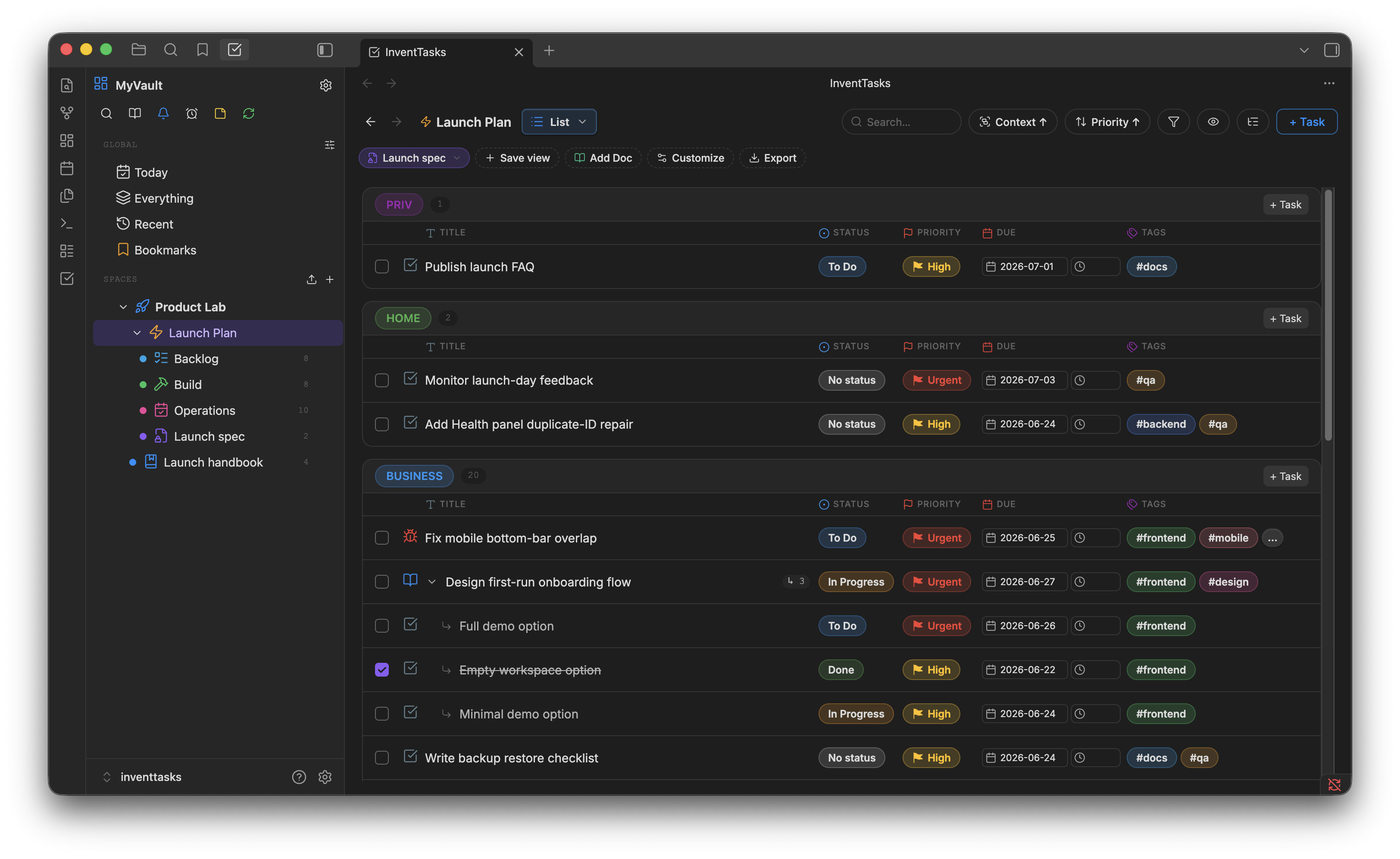
Notion's good idea was that a page and a database row can be the same thing. Give an item properties, point it at other items, then look at the whole set as a table, a board or a calendar depending on the question you are asking.
Its cost is the storage model. A Notion page is a tree of blocks in a hosted database. Nothing on your disk resembles what you see on screen, the export produces files that no longer behave like the thing you exported, and the whole structure needs Notion running for it to mean anything.
InventTasks keeps the shapes and drops the storage model.
What carries over#
| In Notion | In InventTasks |
|---|---|
| A database | a list, holding notes in a folder |
| Properties on a row | 24 custom field types in YAML frontmatter |
| Select and multi-select | dropdown and labels fields |
| Relation properties | relationship and doc_relationship fields |
| Table, Board, Calendar, Timeline views | six views over the same tasks |
| Rollups and formulas | per-column sum, average, min, max, range, checked percent, regex match count |
| A page inside a row | the note itself — the task is the page |
That last row is the one that changes how it feels. In Notion a task has a page attached to it. Here the task is a Markdown note, so writing into it is just writing, and everything Obsidian does to notes — backlinks, search, the graph, your themes — applies to your tasks without any integration.
What you don't give up#
- Your files. One note per task, YAML frontmatter for the fields. Open them
in any editor,
grepthem, keep them in Git. - Working offline, always. No server sits between you and your own data.
- Reading it in ten years. There is no export step, because there is no proprietary format to export from.
- A real vault. Your tasks live beside your notes rather than in a separate product you also have to open.
Need it on more than one machine? The self-hosted sync server is free and unlicensed, and runs on hardware you own.
What Notion does that this does not#
- It is single-user. No shared workspaces, no assignees, no comment threads.
- No arbitrary databases. This models tasks and documents. It will not hold your CRM, your reading list and your recipes as three different schemas.
- No block editor. Notes are Markdown, edited in Obsidian, not a canvas of draggable blocks.
- No web publishing. Nothing here turns a page into a public URL.
Notion is a better Notion. This is for the part of Notion you were using as a task manager.
Where the data lives#
---
id: TSK-00214
title: Draft the Q4 partner brief
status: in_progress
priority: 2
tags: [partners, q4]
due_date: 2026-10-14
cf-client: Northwind
cf-stage: review
---

Three sections: scope, pricing, and the escalation path.
The free version holds 50 open tasks across 5 lists, which is enough to move one database over and find out whether the shapes really do survive the trip.