Six views of the same tasks, 24 custom field types, dependencies, notifications, calendar sync and a free self-hosted sync server. Nothing is stored in a proprietary database — every task is a note you can open, read and keep forever.
Obsidian already stores your knowledge well. What it lacks is a place for work
that has a state, a date and an order — and the usual answer, a checkbox in a
note, stops scaling the moment you have more than one project.
InventTasks adds the missing layer without moving anything out of the vault.
Spaces, folders, lists and tasks are directories and Markdown files. Statuses,
priorities and custom fields are YAML frontmatter. Configuration is Markdown
too. You can read all of it in a text editor, keep it in Git, and take it with
you if you ever stop using the plugin.
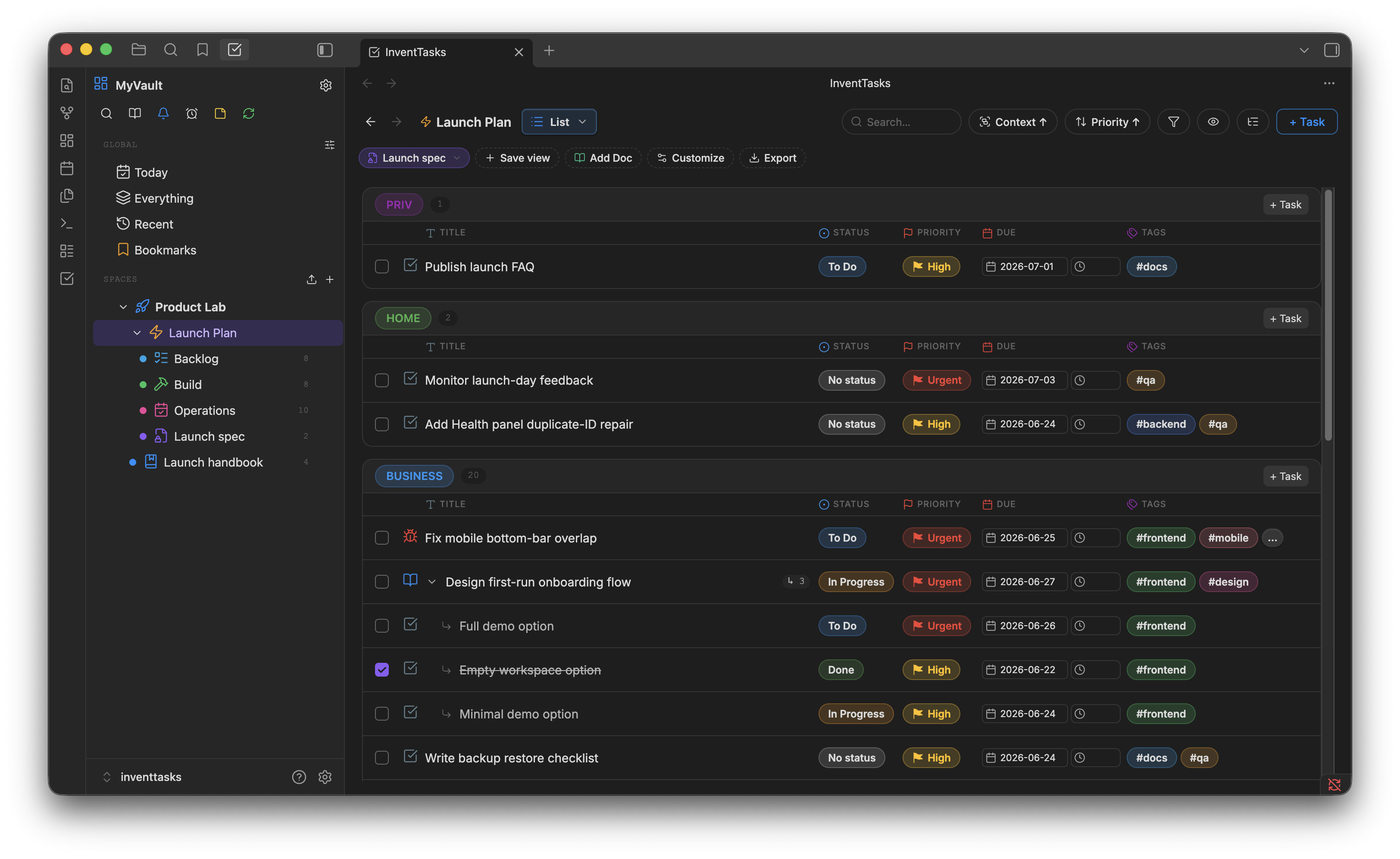
List for grouped rows with inline editing and column calculations. Board
for drag-and-drop Kanban. Calendar for month, week and day. Table for
spreadsheet-style bulk edits. Gantt for the shape of a project. Timeline
for chronological lanes.
They are layouts, not modes — filters, grouping, sort order and saved views
carry between them, and an edit in one shows up in all the others because there
is only ever one underlying note.
Workspace → Space → (Folder) → List → Item → Subitem
Every level can override the one above it: its own statuses, priorities, item
types, tag palette, custom fields, view defaults and feature toggles, each set
to inherit, on or off. A client Space can run Scrum statuses while your personal
Space stays at "todo / doing / done", without two plugins or two vaults.
The free version is not a trial and does not expire. It includes every
feature — Gantt, custom fields, notifications, calendar sync, the lot — within
a capacity of one workspace, one Space, five lists and fifty open tasks. Tasks
you finish stop counting. A one-time Pro licence lifts the capacity; it does not
unlock features you were locked out of.
Whole-vault self-hosted sync and the browser app are free at any tier.